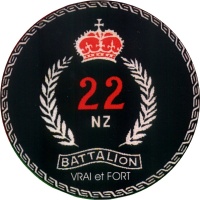
22battalion crest

22nd Battalion 2NZEF

"Vrai et Fort"


22 Battalion Enters Trieste

On 2 May 1945 'A' and 'C' Companies of the 22nd Battalion raced northward along the Adriatic Coast towards Trieste. 'B' Company had been left behind for a few days in Venice. Their mission was two-fold, to enter Trieste and end the war in Italy, and to get there ahead of other elements of the 8th Army, in particular Div Cav who were taking the high road above the town. Despite some reports in the official history to the contrary, it was 22 Battalion that entered the city first. As they entered, they found that the Yugoslav partisans had already arrived, and dealing with them complicated the issues.

The narrative recorded on this website has come from the personal recollections of those present on the day. The events are near-identical to the "official" record as written up at the time in the 22 Battalion War Diary, as filed with Div HQ.

Images of the War Diary for April and May can be viewed here.

I have located a number of photos taken as the New Zealanders entered Trieste, and of the incidents that followed. These photos have mostly come from two sources that are difficult to access. One is the photo-journalism book "Trieste Diary", wriiten and published in Italian by Sylvia Sprigge. You can view pages of the book here.  The other is an Italian website with some of the history of Trieste.

Miramare Castle

Miramare lies on the coast about 5km south of Trieste. It was the HQ for a German Division, but they quietly surrendered to A Company of the 22nd, prompted in part by a severe pounding of the surrounding air defences by several squadrons of bombers. The large German flag that flew over the castle was removed by A Company, who all signed their names on it. The flag is now on permanent display in the Waiouru Army Museum.

Miramare Castle

German surrender at Miramare Castle. Capt Jock Wells (with cigarette in mouth) negotiating

Miramare Castle

At Miramare, German officer addressing his troops

Miramare Castle

Miramare. (Malcolm Waller of A Coy, looking to his left)

Miramare Castle

Miramare. Motorcycle dispatch rider with goggles

Miramare Castle

Miramare. Dispatch motorcycle, with German medical officer on right

Miramare Castle

The German flag removed by "A" Company, 22 Battalion on 2 May 1945

Miramare Castle

Miramare Castle, taken in 2005

Miramare Castle

Miramare Castle, taken in 2005

Miramare Castle

The view from Miramare towards Trieste

The road to Trieste

The 22nd Battalion was stopped at a number of points on the road into Trieste, clearing roadblocks and dealing with Germans only some of whom wished to surrender. Eventually LTCOL Haddon Donald was approached by a group of Germans which included an officer and radio operator. They accompanied Haddon into Trieste, navigating and advising local German units of their arrival.

Trieste

Approaching Sistiana

Trieste

Dealing with roadblocks

Trieste

Guarding prisoners near Trieste

Trieste

Haddon Donald seeking directions

Trieste

Haddon's jeep nearing Trieste

Trieste

Trieste in the distance

Trieste

Approaching Trieste

Trieste

Near Trieste

Trieste

The last past of the road

Entering Trieste

The 22nd Battalion was accompanied into Trieste by the Lancers and some armour, both under Lt-Col Donald's command. They were welcomed by the Triestini, but the Yugoslav partisans were less keen, althought here are several photos showing the two forces geting on well enough together.

trieste
trieste
trieste
trieste
trieste
trieste
trieste
trieste
trieste
trieste
trieste
trieste
trieste
trieste
trieste
trieste
trieste
trieste

More from Trieste

trieste
trieste
trieste
trieste
trieste
trieste

The Albergo Roma, home of A Coy

The Tribunale Building

For Colonel Donald and the New Zealanders who first arrived in Trieste, the Tribunale (Law Courts) building was occupied by belligerent SS officers who refused to surrender.  To quote the Official History:

"At the Tribunale Donald could not persuade the garrison commander to surrender; he was an SS officer who was still humbugging undecidedly and was apparently under the influence of alcohol.'  Donald therefore arranged with the Yugoslav commander that tanks of C Squadron of 19 Regiment and C Squadron of the 20th would surround the building and give it a 20-minute pounding with their guns and Brownings. First the square was cleared of all troops and civilians, and at 7 p.m. 18 tanks at ranges of from 20 to 50 yards blew gaping holes in the walls and through the windows of the Tribunale. The Germans took shelter in the cellars and had few casualties, but the Yugoslavs entered the building and by morning had rounded up some 200."

In his book "In Peace and War", Lt Col Haddon Donald, commander of the 22 Battalion, recalls:

"....I decided to try on my own to persuade them to surrender. With no flag of truce available, I made do with my handkerchief, which was white and reasonably large... I knew enough Italian and German to be able to explain who I was... and we would give them safe conduct back to a British prisoner of war camp.....They stepped back inside and slammed the door." 
"I was fast losing patience with the SS types in the Tribunale, but decided to have one more go at offering then safe conduct.... Terry McLean, my adjutant, could speak some German and by this time an Austrian civilian had joined us to act as an interpreter. The three of us, under a better constructed white flag marched once more across the Square to parley with the Germans."
"I gave the order to fire and keep firing until we had blown several entries into the building.... The tank boys were having a wonderful time. Never had they had such an easy target and nobody was shooting back at them."

The shelling of the Tribunale was one of the few incidents of damage inflicted by the New Zealand troops on arrival at Trieste. A few photographs survive from the event.

tribunale

A postcard of the Tribunale pre-1939.

tribunale
<>Negotiations - part 1
tribunale

Deciding on the next move

tribunale

Surrounding the building

tribunale

The Yugoslav partisans waiting to enter the building

tribunale

Deciding on another approach - note the larger white flag

tribunale

The tanks in waiting

tribunale

The tank boys

tribunale

A Yugoslav tank


tribunale

Waiting

tribunale

More tanks

tribunale

Ringing the building

tribunale

The aftermath

tribunale

Surrounded

tribunale

The damage

tribunale

A photo after the event

tribunale

The Tribunale today

tribunale

The Tribunale

Castle San Giusto

Overlooking Trieste and its harbour is the ancient castle of San Giusto, lying next to the cathedral of San Guisto. The castle housed a German garrison and as they occupied a commanding position over the city, Haddon Donald decided they needed to be removed as soon as possible. He sent C Company, led by Major Lloyd Cross, up to the castle where they met the CO, an Admiral. He was willing to surrender but the Yugoslav partisans had other ideas, threatening to shoot any person, German or Allied, who left the building. As Major Cross only had a depleted company, and no tanks or armour, he decided to stay in the castle until relieved. The Admiral pointed out that the Kiwis only had a small force whereas the Yugoslavs had a heavily armoured force. Disretion prevailed, and although the Germans piled most of their arms into a room, sentries were posted around the castle that night of Kiwis alternating with Germans - a most bizarre end to the war. But as Major Cross pointed out to the Admiral, his troops had not eaten since breakfast and they had not brought rations with them. The Admiral sat them down to eat with his men. The menu was stew - made from horsemeat. Major Cross dined with the German officers, and they had stew - from horsemeat, washed down, not with Italian wine or good brandy, but Scotch whisky, the last remnants from the fall of Tobruk.

The official history records the facts:

A company of the 22nd Battalion proceeded to the 750-year-old castle of San Giusto, the ancient citadel of the port, to receive the surrender of nine officers and 260 men. In the central courtyard, the company drew up opposite the paraded garrison, and returned the salute in a ceremony which had all the appurtenances of a military occasion. Bullets from Yugoslav snipers pattered against the old walls. As the prisoners moved out the following day partisans demanded that the Germans be handed over to them. Tactful handling prevented trouble.

Here are some photos of that time at San Giusto, together with photos I took in 2005. Note the Cenotaph flanked by yew trees appears in both sets of photos. Sone of the 1945 photos come from this website

castle

Monsignor Santin assisting with the German surrender.

castle

Looking across the courtyard to the Castle

castle

The entrance to the Castle courtyard

castle

The commander of the German garrison negotiating with the Kiwis

castle

A tank on the courtyard

castle

Another tank

castle

Looking down on the assembled tanks on the courtyard. Note the Cenotaph

castle

Preparing to depart

castle

Looknig across to the castle

castle

The German officers departing

castle

The cenotaph today

castle

The castle and the Roman ruins

castle

The view of the port of Trieste from the Castle


How the media saw the 2 May 1945

Here is the article from page 4 of the London Daily Telegraph of 4 May 1945. You can also download the whole page as a PDF file here.

Daily Telegraph


The Final Act - The Cold War Begins with the death of John Russell

After the fall of the Tribunale Building, and the formal surrender of all German forces in Italy to Col Donald, there was still a garrison of German soldiers at the Villa Opicina, overlooking Trieste. The German commander sent a message to Col Donald that he wished to surrender to the New Zealanders, so Haddon sent part of A Company with some tanks and trucks up to the Villa. Once there they found the place surrounded by Jugoslav forces who wished to capture the Germans. During the negotiations, the Jugoslavs lobbed a mortar into the town square wounding one Kiwi and killing Lance Corporal John Russell. He became the last New Zealand casualty of the war, and the first casualty of the Cold War that developed from the standoff between Juoslav and Allied forces in Trieste.

The men of the 22 Battalion were particulary aggrieved at the loss of L/Cpl Russell. It is a lasting testament to their professionalism that they did not return fire.

JN Russell 297309 L/Cpl John Norris RUSSELL
(Photo from Russell family collection)
Russell headstone Private Russell's headstone at Udine Cemetery, Italy.

Return to main index

Last updated: 19/08/2011